

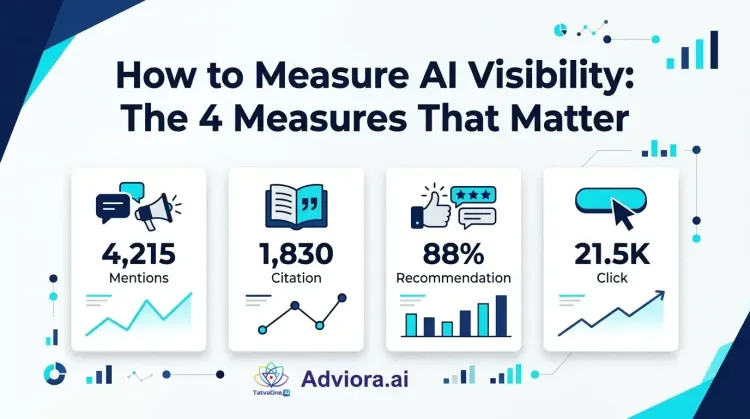
How do you measure AI visibility?
Ask the engines what your buyers ask, then count what comes back. There are four things worth counting, they live in two different places, and most of the effort goes into counting them the same way every time. If you work on Generative Engine Optimization (GEO) or Answer Engine Optimization (AEO), this is the part that tells you whether any of it is working.
A single percentage on a dashboard is fine for a summary slide. The trouble starts when someone asks what to do about it. Picture an answer that cites your pricing page as a source and then recommends a competitor anyway. A score that blends everything would count that as a good result.
The four AI visibility metrics, on one example answer
Illustrative example. The brands are placeholders.
Here's a prompt a real buyer might type: "What is the best payroll software for a 50-person company in India?" Take one answer and go through it four times, looking for something different each time.
| Measure | The question you ask | In the example answer | Where you count it |
| Mention | Did the answer name your brand? | "Popular options include BrandA, BrandB and YourBrand." | The AI answer |
| Citation | Did it link to or credit your site as a source? | A source link to yourbrand.com/pricing | The AI answer (Gemini reports domains rather than full page links) |
| Recommendation | Did it pick you for this buyer's need? | "For a 50-person team in India, BrandB is the best fit." You weren't picked | The AI answer |
| Click | Did anyone visit your site from it? | A session with chatgpt.com as the source in GA4 | Your analytics |
So, one answer: you got named, your pricing page got cited, and BrandB got the recommendation. Whether anyone clicked through, the answer itself can't tell you. Fold all that into one score and it looks like a decent day, while the buyer is off reading about BrandB.
Pretty much any AI visibility metric you'll see reported is one of these four, or a mix of them, counted over some set of prompts, engines, runs and dates. When a tool shows you a "visibility score", it's fair to ask which mix it is.
When a single AI visibility score misleads
Engines don't move together. It's quite possible to gain ground on Perplexity in the same month you slip on Gemini, and an average of the two will sit there flat, hiding both changes.
The measures also drift apart from each other, and those gaps tend to be the expensive ones.
- Being mentioned a lot isn't the same as being recommended. A score built mostly on mentions can look healthy while your pipeline tells a different story.
- You can be named without being cited, or cited by an answer that then picks a competitor. Each needs its own fix, so it helps to see them separately.
- A crawler fetching your page, an engine citing it and a person visiting it are separate events. Your server logs show the crawl, but only the answer shows the citation, and only analytics shows the visit.
Mentioned but not linked: what it means and what to do
It's common for an engine to name a brand and link somewhere else entirely. Usually the model knows who you are, but the evidence it leaned on came from a review site, a comparison piece or a directory. The reverse happens too. In Adviora's sample report, Claude and Gemini kept citing one site on a buying question without ever naming the brand behind it (sample report, sample data).
So the fix for an unlinked mention usually isn't on your homepage. Open the answer and look at what it did cite. That's where your LLM citations are actually being decided.
Your own pages still count. Say plainly what you sell, who it's for, what it costs and where you operate, in sentences a model could lift without rewriting. Then go after the third-party pages the engine already trusts.
One thing that's easy to overlook is consistency. Keep the brand name, description and key facts the same on your site, your profiles and your listings, and make sure your structured data matches what's actually on each page. When an engine finds three slightly different versions of your company, citing someone else becomes the easier option.
How many answers do you need behind each figure?
Run the same prompt twice and you may get two different answers. That's normal, and it's why every figure here is really a rate taken from a sample. Small samples jump around. Write the number of prompts, the number of runs and the date range next to each figure, or nobody will be able to tell a real change from a wobble.
Go easy on branded prompts. Ask "What is [brand]?" and you'll almost always get named, which pads every number and says nothing about whether a stranger would ever find you.
A confidence label next to each number helps a lot. Here's the rule Adviora uses (methodology, updated 9 October 2026):
| Confidence | What sits behind the figure |
| High | At least 100 observations, across at least 10 prompts and at least 3 runs |
| Medium | At least 30 observations |
| Low | 29 observations or fewer |
Your thresholds can be different. What matters is having some, in writing, so a figure built on 20 answers doesn't get the same airtime as one built on 200.
Where share of voice and clicks fit
Share of voice is really a mention measure with competitors in the denominator: your mentions divided by the mentions of you plus a fixed list of rivals, over the same prompts. Change the list and the number moves, so write it down and leave it alone. There's a worked example in AI share of voice.
Clicks live in analytics, and you won't catch them all. Plenty of AI answers never send anyone anywhere, and some visits that do arrive show up without a clear source. Think of the click count as a lower bound. Our guide to tracking AI referrals in GA4 covers the setup.
A simple sheet for tracking all four measures
You don't need a tool to start. A spreadsheet works, with one row for each prompt, engine, market and run:
| Date | Market | Engine | Prompt | Mentioned? | Cited? (URL) | Recommended? | Competitors named | Raw answer |
| 15 Nov | US | ChatGPT | Best payroll software for a 50-person team | Yes | No | No | BrandA, BrandB | (paste the full answer) |
The rates fall out of the sheet with simple counting. Mention rate is answers with a mention over answers recorded, and citation and recommendation rates work the same way. Clicks come from analytics, for the same dates.
Paste the full answer into every row, even though it makes the sheet long. Sooner or later someone will question a number in a meeting, and showing them the engine's actual words settles it quicker than any chart.
How often should you measure AI visibility?
By hand, monthly is usually plenty, with an extra round after a big change to your site, product or pricing. Check more often than that and you're mostly recording small-sample noise. Leave it much longer and it gets hard to tell which change moved anything.
Tools shift that balance because they can run far more answers. Adviora, for instance, runs every prompt weekly on every engine and shows the trend over several weeks, so one strange week doesn't drag the picture around.
Whatever you choose, keep the prompts, engines and markets fixed between rounds, otherwise you're comparing two different measurements.
How Adviora reports each measure
Adviora is an AI search and SEO visibility platform from TatvaOne.AI. It tracks your brand across Google and six AI engines, ranks what to fix first, and can fix it for you at a fixed price.
Its AI Visibility Score is the share of relevant AI answers that name or cite you. Because it's built from the separate measures above, you can break it down by product, market and engine. Every answer is stored with its citations, so a figure can always be traced to the exact words an engine used. For each product and market, Adviora records whether you were mentioned, whether one of your pages was cited, and your position (the order in which brands are first named). Each figure has a confidence label, and cited sources are sorted into ten categories, such as review platforms, forums and publishers, then marked as yours, a competitor's or a third party's (methodology).
| Measure | How Adviora covers it |
| Mention | Recorded per answer, per engine, for each product and market |
| Citation | Recorded when an answer links to one of your pages; cited domains classified by source type |
| Recommendation | Shown through position (the order in which brands are first named in each answer) and the stored answer text, so you can see which brand an engine picked for every prompt |
| Click | Comes from your analytics, not from the AI answers |
Paid plans track six AI engines (ChatGPT, Claude, Gemini, Perplexity, DeepSeek and Mistral Vibe) plus Google Search. The free audit covers five of them, with Claude added on paid plans.
Whatever tool you end up with, ask to see these measures separately, and ask to read the answers behind them. If all it can give you is one number, you're missing most of what you'd want to know. Comparing tools? Why AI visibility tools disagree has an eight-step test you can run before paying for any of them.