

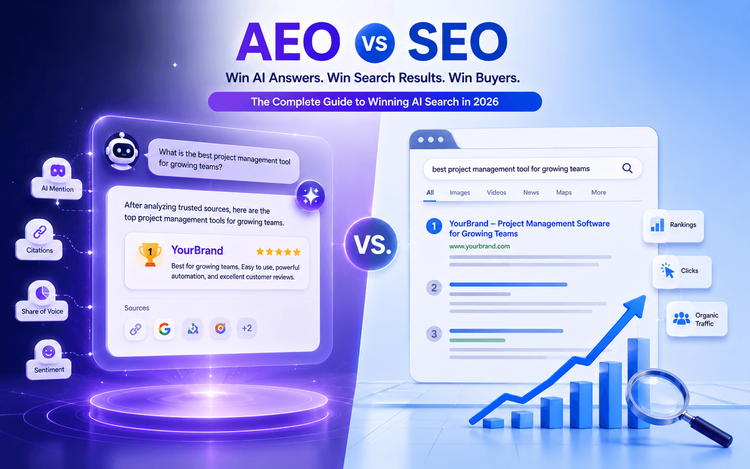
How Search now operates has been transformed. Your user is not coming to search for their search query and then being presented with 10 blue links; they are now being given a single answer from a Google AI such as ChatGPT, Google AI Overviews or Perplexity. If you're not being used as the source of the answer then you'll be ranked below and won't even be shown. Organising your content is therefore more important than ever to ensure that your website is featured. As your users are making the decision at this stage, your brand might not even feature anymore.
This article will cover the distinctions between traditional SEO and the new Answer Engine Optimization (AEO).
The Two Disciplines
SEO is the science of knowing how to write stuff that lands in a position on the search engine result page such that it can be clicked on by humans, google bots and spiders. Use backlinks, page authority, keywords and technical SEO to get that ranking.
AEO is the practice of designing your content to put you in the running for being identified as a trustworthy source by AI answer engines such as ChatGPT, Perplexity, Google AI Overviews, Gemini, Copilot and voice assistant.
Where SEO receives rankings AEO gets selected This is not an exception anymore either. Google's AI Overviews have said to be scaled to about 1.5 Billion new users per month since Google I/O 2025 in general. It is hard to say whether this is the real number, but this brings to see how this is going to be the standard in search.
Why AI Search Is Harder to Win Than Traditional SEO
The uncomfortable truth for most SEO teams: the playbook that got you ranked on page one doesn't reliably get you cited in the answer above it. Ranking position and AI citation are correlated but no longer tightly coupled - a #1 Google ranking no longer reliably means you'll also be the source an AI system cites. A strategy that can't account for this shift can't win the moment that matters most: the one before the click, if there's a click at all.
What's changed underneath the surface:
- Zero-click search is now the majority behavior. SparkToro's long-running zero-click research puts the share of U.S. Google searches ending without a click at roughly 58–60% in its most recent widely-cited figures - the answer is delivered directly, and the searcher never visits a website.
- AI Overviews show up often, and growing. AI-generated answer summaries now appear across a large and expanding share of Google search results, per BrightEdge's tracking of the rollout.
- Ranking position is losing predictive power. Being the top organic result is no longer a reliable proxy for being the source an AI system chooses to cite.
- Voice search is AEO in its purest form, even though the "what share of searches are voice" statistic has a messy history in this industry - several widely-repeated voice-search percentages over the years have turned out to be unsourced or outdated. The safer, structural claim: a spoken answer only has room for one source, so it's either 100% share of voice or zero - the exact binary outcome AEO is built to win.
The Citation Signal Framework
AI systems aren’t simply focused around rankings. A controlled academic study (commonly known as GEO: Generative Engine Optimization) has been conducted by researchers from Princeton, GA Tech, and the Allen Institute for AI. This has identified that there are several specific signals you can improve in your content to influence how much of the AI generated answer your page is given. Below are the four signals we know you should aim to improve:
- Quotable Content – Adding quotes from trustworthy sources within your content increased visibility.
- Statistical Content – Adding specific stats increased visibility.
- Citations – Including references to authoritative sources increased visibility.
- Recent Commercial & Evaluation Content – Content that is recent seems to get more citations from the AI for commercial and evaluation queries.
You may have seen some specific stats mentioned in relation to the academic study above. For example, the exact percentage increase from using quotes, stats and citations. You should always refer directly back to the paper for these exact figures. We know that this is an overall positive trend, but we recommend you always check the page level citations for the exact numbers.
Feature Comparison at a Glance
For the technical foundation behind traditional search visibility, explore Adviora's Technical SEO Intelligence
| Capability | Traditional SEO | AEO (Answer Engine Optimization) |
| Primary goal | Rank on the results page | Get selected as the cited source inside the answer |
| Success metric | Position, clicks, CTR | Citation rate inside AI-generated answers |
| Content structure | Keyword-targeted long-form pages | Question-shaped headings, answer-first formatting |
| Authority signals | Backlinks, domain authority | Backlinks *and* brand mentions - several industry analyses suggest mentions correlate more strongly with AI citation than backlinks alone⁸ |
| Freshness requirement | Periodic updates | Higher - commercial-intent AI citations skew toward recently updated pages⁷ |
| Structured data | Helpful, not critical | Core requirement - FAQ, HowTo, and Organization schema make content machine-readable |
| Voice search coverage | Minimal | Direct - AEO is the only discipline built for single-answer voice queries |
| Measurement | Rank tracking, organic traffic | Citation frequency, AI mention tracking, share of AI-generated answer |
The pattern is clear: traditional SEO still wins on breadth and established infrastructure, while AEO wins on the specific mechanics that determine whether AI systems cite you at all. Most teams don't need to pick one - they need both, connected.
What Strong AEO Actually Does
Judge a content strategy against the same four-signal framework above, applied practically:
- Structures content around direct questions - question-shaped H2s that mirror how buyers actually ask AI assistants things, with the answer delivered in the first 1–3 sentences.
- Backs claims with citable specifics - real statistics, named sources, and direct quotes, since this is the most research-backed lever for AI citation currently available.
- Stays current - treats high-intent commercial pages as living documents given how strongly freshness appears to predict citation.
- Standardizes entity information - brand, product names, and category positioning described identically across the site, schema markup, and third-party listings.
- Earns mentions, not just links - digital PR and third-party coverage alongside traditional link building, given the apparent relationship between brand mentions and AI citation.
Why Freshness and Citations Matter Most
AI systems have a catch: they can only cite what's clear, current, and verifiable. A page with vague claims and no supporting data gets skipped in favor of a competitor's page with a named statistic and a recent update - and nothing costs a brand visibility faster than being technically accurate but functionally uncitable. The fix is a documented, evidence-first content model: real data, named sources, and a visible update cadence that gives an AI system a reason to trust the page enough to quote it. That turns AEO from a theory into something measurable - protecting both the brand's visibility and its credibility when it does get cited. It's also, not coincidentally, the exact standard this document holds itself to - see the sourcing notes in the optimization report below.
Best Fit by Use Case
For brands with an established SEO foundation looking to extend into AI-search visibility, layering AEO onto existing high-authority pages is the fastest path - structure and citations first, new content second. For newer brands or category challengers, AEO can be a genuine first-mover advantage: industry surveys suggest a meaningful gap between how many marketers believe AEO will matter soon and how many have actually started implementing it⁹ - so the competitive bar is still low in most categories. Traditional SEO alone remains the stronger sole focus only where AI-generated answers haven't yet meaningfully entered a buyer's research journey - a shrinking set of categories as AI Overviews expand their reach.