

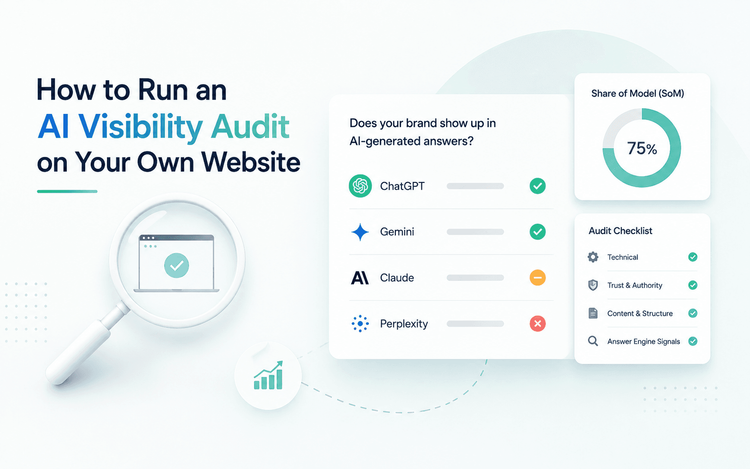
What's different about an AI visibility audit from an SEO audit
It's very much like solid SEO, but three things are different. Instead of a keyword, the unit is a prompt, the question a buyer asks. Instead of a position in the SERP, the answer names you or leaves you out. Instead of being stable, the answer varies on each run. An audit of Generative Engine Optimization (GEO) is exactly that sort of exercise, regardless of what the teams calling it say.
Step 1. Select a group of buyer prompts
A buyer prompt is the query that a person searches before they learn your brand " top HRMS in India", "accounting tools for small companies", "payroll software costs in India" The majority of your set ought to be unbranded, because that's where purchasers find options and where models most frequently fade away. Include a few branded prompts so you can see how engines describe you as soon as they recognize your name.
Construct the kit from three sources:
- Your website. What pages do you have, what are they about and for whom, what challenges do they address and what markets do they serve? Make each one of those a question a buyer might ask.
- Google. Use the related searches and People Also Ask questions for your topics as the basis for your conversational prompts.
- Sales and support. Their calls surface pricing, integration and comparison questions that never show up in keyword tools.
Adviora constructs the same prompts: it crawls a site to determine that site's intent, customer persona and messaging; it crawls search engine results data, generating a prompt from People Also Ask questions - but keeping the questions in the text.
Sort prompts by product, market, and buying stage:
| Buying stage | Example prompt | What to look for |
| Discovery | “What are the best payroll software tools for a 50-employees company?” | Whether you appear among the options |
| Comparison | "Zoho Payroll vs. greytHR: Which suits a 50-employee company?" | How you are positioned and described |
| Requirement | "Which payroll software is suitable for an Indian startup with 50 employees that needs PF, ESI and attendance management?” | Whether you appear for your strengths |
| Purchase | “Want exact pricing and breakdown for top Indian payroll software?” | Whether you are recommended, and at what price |
Begin with 20-30 prompts and give more prompts for each additional product or market. Adviora's original baseline was 22 prompts, mostly us, with one India prompt for rupees. When the batch is determined, make it final: alter prompts and you cannot compare one audit to the next.
Step 2. Run the prompts through the engines
Select the engine you want to use with your buyers, then keep track of all the different combinations you try, including your prompt, the engine, the mode or model, date, language / market, and the full output. An AI's output will be inconsistent, so run the prompt multiple times and note what percentage of the time it produces that result.
Include what you have measured Responses from an API will differ from those in the set up in the AI visibility engines/agents, so do specify which you are quoting. Adviora's baseline is based on websearch and localisation and live API samples from ChatGPT, Perplexity, Gemini and Claude so those figures are API responses localised as per user not consumer-app screens.
This is how an AI search visibility audit crosses into your market. A single brand is visible to US buyers, then goes off the grid for Indian buyers, so run each market with its set of location selectors. The free Adviora audit includes all the set of AI search tools, including ChatGPT, Gemini, DeepSeek, and Perplexity; the paid plan and free trial adds ChatGPT, Claude, Perplexity, Gemini, DeepSeek, Mistral Vibe, and Google AI Overviews, with each product set and each market tracked separately.
Step 3. Record mentions, citations, recommendations and accuracy
Number your columns, and for each answer, include: called your brand, listed your site (and what URL), recommended for the buyer's need, description was correct. (keep them separate). You can be cited on a page while your competitor gets the recommendation, a brand can be listed a dozen times without every being recommended. That's the heart of any LLM audit, and that's why one big blended visibility number conceals far more than it reveals.
One by one they are each simple: stumped - those where it happened, over the number of answers you recorded it. If your brand is caught 15 times in 60 answers recorded then your featured rate is 25% of the answers you tested - NOT 25% chance of the sniff out for every buyer.
This is the baseline of Adviora for one of its group sites:
| Measure | Unbranded prompts | Branded prompts |
| Brand named | 8 of 15 answer cells | 4 of 4 |
| Brand website cited | 2 | 4 |
Engines knew brands when asked by name and omitted it when the buyer did not, so that is the exact hole an audit is designed to fill. Count AI referral visits in GA4 as a fifth, stand-alone, measure, aware that the numbers are partial, because many AI answers generate no click at all.
Step 4. To the bottom: resources, crawl access & markup
- Sources and contenders - Categorize all your cited URLs into your own pages, competitor pages, and third-party websites, like review sites, directories, or comparison listings. If your competitor wins the vote of recommendation, very often it's because they're listed on a third-party list or review site and you're not. But a listing still holds no guarantee, so treat each with suspicion.
- Accuracy - Cross-check what the answers claim about your prices, products and company with your own pages and top profiles. Fix the facts you're aware of first, then seek the writers that still have older details to update theirs.
- Crawl access - Review robots.txt groups and server responses by user agent, but keep in mind that crawlers are used for different things: ChatGPT search with OpenAI's OAI-Search Bot, vs. model training with GPTBot (OpenAI crawler docs). Review CDN rules and firewall rules too. The AI crawler access audit is complete on this method.
- Markup & trust pages - Make sure structured data exists and is consistent with the page as shown (no longer helps for FAQ schema and AI search), that there are author and business pages (E-E-A-T for AI search) and each page has a straight answer in the first 100 words. For free automated first pass, try our free AI visibility audit.
Step 5. Rank the findings into a fix list
Score each finding on impact (how many buyer prompts or key pages it affects), confidence (how strong the evidence is) and effort, and give it an owner. Here are one of findings from 15 October, ranked:
| Finding (15 Oct 2026) | Impact | Confidence | Effort | Fix | Owner |
| Named in 0 of 15 unbranded answers | High | Medium (one baseline) | High | Earn places on the third-party lists and comparisons engines cite; publish comparison content | Marketing, content |
| robots.txt rule in the wrong user-agent group | High | High | Low | Correct the group and retest each crawler | Dev |
| No Organization markup | Medium | High | Low | Add Organization schema with legal name and sameAs links | Dev, SEO |
| 38 broken internal links to 21 dead URLs | Medium | High | Low | Fix links in navigation and CTAs first | Dev |
Once the fixes ship, run that frozen prompt set under the same circumstances again and compare each measure on its own. If citations go up but recommendations remain flat, your content is being found but not yet selected. Engines also change themselves over time, so compare against your competitors' results from that same run before you give credit or take blame for a fix.
What each fix costs as a pack
You can do all of the above yourself. If you would rather have it done, each finding maps to a fixed-price Action Pack:
AI Visibility Baseline Audit: $750 / ₹22,000 (buy an audit)
AI Crawler Access and Technical Fix: $650 / ₹22,000
Schema Markup Implementation: $650 / ₹22,000
E-E-A-T and Trust Foundation: $750 / ₹25,000
AI Answer Readiness, full stack: $2,400 / ₹78,000
Whoever does the work, be wary of anyone who guarantees placement in ChatGPT or Gemini answers. Nobody controls what those systems say.