
Zero-click searches and query fan-out: what changes for your pages
Zero click searches are searches where the user receives the information they need on the search results page (or within the AI answer). Query expansion is when an AI takes the initial search query and expands it into multiple related searches. It then uses the pages to create its answer. Both reward pages that clearly answer the query and fully cover that topic. They won’t reward pages that have a unique page for each variation of the search. This page will help you explain to leadership next week why you’re seeing more impressions but no increase in clicks. We’ll cover the two mechanisms in play, what you should improve on your pages and how to interpret Search Console.

Published 27 August 2026Updated 10 November 20266 min read
Key notes
- Zero-click is nothing new. We've had featured snippets and knowledge panels doing this for some time. Now we have AI Overviews and AI Mode allowing us to get a zero click answer for longer queries.
- Google state that pages must be indexed and available to show in the AI features. There is no special file or markup needed.
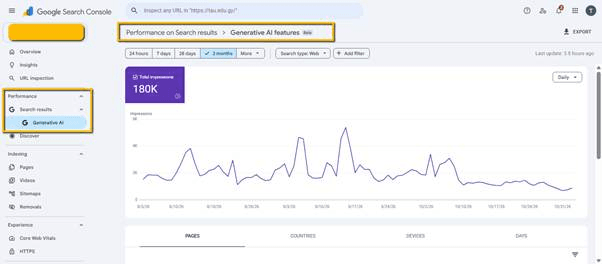
- Clicks from AI features will be included in your normal Web report within Search Console.
- With query fan out, one query can lead to multiple searches. Having a clear section for each sub query increases the chance of using your page.
Creating pages for each variation or for each AI engine would fall into the scaled content pattern described in Google's spam policies. Have these as sections of one page.
What zero-click means in 2026
A search is zero-click when the searcher gets what they need without opening a site. That answer might come from a featured snippet or a knowledge panel. More and more, it comes from an AI Overview or an AI Mode answer.
Google hasn't said much about this, but what it has said is clear. Pages that appear in AI Overviews and AI Mode must be indexed and eligible to show a snippet. There's no special file or markup for it. And clicks from AI features are counted inside Search Console's ordinary "Web" report (Google Search Central, "AI features and your website").
You'll find plenty of zero-click percentages quoted online. We don't repeat any of them here. The figures vary widely with method, market and query type, and we only use numbers with a named, dated source.
What query fan-out is
New AI Mode feature at Google I/O in May 2025, Google says "AI Mode uses our query fan-out technology to break down your query into sub-topic questions and run many queries." So basically what happens is that if you pose a difficult question to the AI Mode, it will run several searches related to it. After gathering all the information, it will compile it in order to give an answer.
To illustrate, if you are looking for a product and ask "What is the best project management tool for a 30 person agency who charge clients by the hour?" Then the system might run separate queries for different parts of this question. For instance, searches related to project management tool for agencies, time tracker for billing clients, 30-user pricing and review by agencies. The system would then mention any pages that address each of these questions.
Thus, if your page provides an answer to the whole question and also has information related to each sub-question, there are greater chances of being mentioned. If you only address one part of the question then there are lower chances of being mentioned.
What to change on a page
- Put a 40 to 60 word answer right under the H1. The page can then be used in an answer even when nobody clicks.
- Keep one URL per intent. Cover close variants on the same page rather than on separate pages.
- Write sub-questions as H2s, so a fan-out search can land on the right section.
Show a named author, dated sources and matching markup. That makes the page a source an engine can trust. Our E-E-A-T checklist covers the details.
If you're not sure which sub-questions your page is missing, a content gap analysis is a good place to start.
If your team doesn't have the time to do this, we can do it for you. Our AI Answer Readiness pack covers technical, trust, content and schema work on your priority pages. It includes three answer-format pages and a re-check after 30 days. The price is fixed, and the scope is agreed on a short call before you pay.
Critical SEO mistakes: What not to do in 2026
Avoid creating a separate page for each variant or AI engine. This is the scalable content pattern described by Google's spam policies. We therefore provide engine specific advice as sections in this single guide.
• Don't try to test Google using script based queries. This violates Google's terms of service and will not really tell you much.
• Don't include FAQ schema to get a rich result. FAQ rich results were removed by Google in 2026. See FAQ schema and AI search.
• Don't think of llms.txt as a solution. Google does not use it.
How to measure it in Search Console
Look for increased impressions but steady clicks. Don’t just look at average metrics, you’ll want to look at different position ranges. Filter to show only search type queries, then find out which pages have had an increase in impressions but not clicks.
One thing to note is that Search Console does not provide a breakdown of impressions from AI features vs impressions from other results on the web. This means no-one will be able to give you an exact figure for how much was caused by AI Overviews.
This can be easily tracked with Adviora’s AI Visibility tracking tool. Every week we send your buyer questions to ChatGPT, Claude, Gemini, Perplexity, DeepSeek and Mistral Vibe. We also check Google AI Overviews. We know if your brand is mentioned, cited and where you are appearing with your competitors. Using Citation Intelligence we can tell you what sources are being cited and if any of those sources are supporting your competitors and not you. If your website is not accessible by AI Crawlers or GA4 isn’t picking up AI Referrals then we can help with our AI Crawler Access Fix.
If you need to present this to a client or leadership team, we recommend using the 2 group method to explain why AI Overviews traffic has dropped. To know what to fix first we recommend reading how to get cited in AI search. And if you want to understand the 3 way comparison then read our article on SEO vs GEO vs AEO.
How to explain it to leadership
Keep it to three points.
1. More impressions due to more of your pages being shown for more queries.
2. However, we didn’t see an increase in clicks as some of the answers are now shown within search or in AI answers.
3. We ensure that each page has the most clear answer for that topic. We also monitor if we are mentioned/cited in the AI answers.
Usually showing the Search Console graph and 1 example query will be sufficient.
If you’re providing monthly reports to your clients then Adviora’s Agency packages include branded reports and automated reports meaning you won’t have to create the slides each time.
How Adviora helps with zero-click and fan-out
We can work with you in three different ways:
1. A free initial audit – we’ll check ChatGPT, Gemini, DeepSeek and Perplexity and give you a list of things you need to fix. No sign-up, no card required.
2. Ongoing support – our plans will run your prompts weekly across six different AI engines and Google AI Overviews to help you gauge if your adjustments are having any impact. All our plans offer unlimited seats.
3. Pay-as-you-go – We have fixed price action packs (such as the AI Visibility Baseline Audit and AI Answer Readiness). We will scope out exactly what we will be doing for you during a 20 minute call.
We cannot guarantee you will get X number of citations or traffic increase – no-one can as the answers from AI will change daily. However, we can tell you where you are currently at, what needs fixing first and if your fixes are helping to improve the numbers.
Ready to see where your demand is really going?
Adviora's Executive Dashboard pairs Search Console performance with per-platform AI citation coverage, so exposure and demand are reported as separate lines.
Frequently asked questions
No. Featured snippets and knowledge panels have answered queries on the results page for years. AI Overviews and AI Mode have extended that to longer, more complex questions.
They can cut clicks on simple informational queries. Your rankings don't drop because of them. If your page is the source an answer is built from, you still get seen, and you can still be cited.
No. Cover sub-questions as sections of one page per intent. Separate templated pages for each variant are the pattern Google's spam policies warn against.
Start by working out the questions a buyer would ask around your main topic. Then give each one of them its own H2, with a short and direct answer just under it. Then link to deeper pages where a section needs more detail.
Not as a separate figure. Fan-out searches happen inside AI Mode, and Search Console counts that traffic inside the "Web" report. You can watch for pages gaining impressions on longer, question-style queries, but you can't isolate fan-out from that data.
Run the same buyer questions through AI answers regularly and note which pages get cited. Adviora's free fix list does this for you and shows what to change first.
We can't guarantee it, and you should be wary of anyone who does. Every Adviora Action Pack lists what we can't promise, and a citation is one of them. What Adviora does is show where you're cited today, find the pages and sources that need work, and help you fix them. Then it tracks whether the citations follow.
CEO
CEO | Education & Tech Platforms | Institution Builder | AI for Learning & Governance | Driving Scalable Education Solutions
More from Vivek Kishore Verma