How ChatGPT, Gemini, Claude, and Perplexity Decide Which Brands to Recommend
For years, earning visibility meant one thing: rank the web page higher on Google. Today there's a second layer. Buyers increasingly ask AI assistants — ChatGPT, Google Gemini, Claude, Perplexity — for product recommendations, software comparisons, and purchasing advice. Instead of a list of links, these platforms generate a direct answer, often naming specific brands and citing sources they trust.
That raises the question this post answers: how do AI assistants actually decide which brands to recommend? The short version is that it's more complex than traditional SEO. Search engines rank pages; AI assistants combine historical knowledge, live web retrieval, entity recognition, and trust signals before generating a response — and each platform weighs these inputs differently, which is why a brand visible in ChatGPT may barely appear in Claude or Perplexity.
AI Recommendations Are Not Search Rankings
The biggest misconception about AI-powered search is that it works like Google. It doesn't. A traditional search engine evaluates billions of pages, scores relevance with hundreds of ranking signals, and returns an ordered list. AI assistants instead synthesize information from multiple sources into one conversational answer — the goal isn't finding the most relevant page, it's producing the most useful answer.
That distinction changes what optimization even means. A page ranking #1 on Google may never get mentioned by an AI assistant. A company with only moderate organic rankings may show up consistently in AI recommendations because its brand is well recognized across trusted sources. Success depends less on where a page ranks and more on how well an AI system understands, trusts, and can retrieve information about your organization.
The Two Universal Inputs Behind Every AI Recommendation
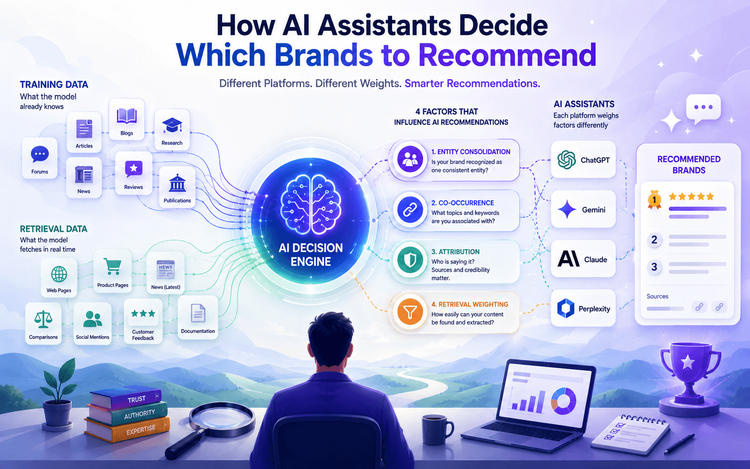
Despite different implementations, ChatGPT, Gemini, Claude, and Perplexity all lean on the same two foundational inputs.
1. Training data — what the model already knows
Training data is the historical knowledge an AI model absorbed during development: public documentation, articles, research papers, forums, reviews, press coverage, and other widely available content. Models don't memorize whole pages — they learn patterns and associations between concepts. For a brand, that means the model gradually builds an understanding of your company name, products, industry, competitors, and reputation.
Organizations with a long history of authoritative publications and consistent messaging tend to establish stronger recognition here. The catch: training data isn't updated continuously. If you launched a product yesterday, a model relying only on historical knowledge may not know it exists yet — which is exactly why retrieval matters.
2. Retrieval data — what the model learns in real time
Modern AI assistants increasingly supplement historical knowledge by retrieving current web content while answering a question — fetching fresh material, evaluating sources, and folding recent information into the response. This is how AI systems answer questions about new product launches, recent announcements, and current pricing.
For a brand, this means publishing good content is only half the job — that content also has to be crawlable, clearly structured, current, and easy to extract. Historical authority builds recognition; fresh, retrieval-ready content builds relevance. Together, these two layers determine whether your organization becomes part of an AI-generated answer.
Four Factors That Influence Whether AI Assistants Recommend You
Every platform runs its own proprietary system, but four mechanisms consistently show up across all of them.
1. Entity consolidation. AI systems first need confidence that different references point to the same organization. If a brand appears inconsistently across its own site, directories, social platforms, and press ("Adviora," "Adviora AI," "Adviora.ai," "Adviora Technologies Pvt Ltd") a model may read those as separate entities rather than one. Consistent naming across every digital touchpoint is what lets a model consolidate those references into a single, well-defined entity worth citing confidently.
2. Co-occurrence. Models learn relationships between concepts by observing what shows up together. If a brand is consistently mentioned alongside terms like "AI Visibility," "Generative Engine Optimization," or "AI search analytics," the model gradually associates that organization with those topics — strengthening topical authority and the odds of appearing when someone asks a related question. Critically, this has to happen beyond your own website too: in industry publications, partner sites, interviews, and research reports, not just your own blog.
3. Attribution. AI systems weigh not just what's said, but who's saying it. A mention in an independent research publication or respected analyst report typically carries more weight than a self-promotional claim on your own site — which is why digital PR, customer reviews, analyst coverage, and editorial mentions matter more for AI Visibility than they ever did for classic SEO. Trust, in this system, is built through independent validation rather than self-declaration.
4. Retrieval weighting. Finally, models weigh how easily information can be extracted during response generation. Content buried in long narrative paragraphs is easy to overlook; content presented as clear definitions, FAQ answers, comparison tables, step-by-step guides, and structured headings is far easier for a retrieval system to identify and reuse. The clearer your information is for a human reader, generally, the clearer it is for a machine too.
Why This Requires a Different Mindset
Traditional SEO trained marketers to think in terms of ranking pages. AI Visibility asks for a different unit of thought: building a trusted entity, not just a well-optimized document. The goal isn't attracting a click anymore — it's making sure an AI system accurately understands your brand, retrieves the right information about it, and recommends your business with confidence when someone asks a relevant question. That shift, from optimizing individual documents to optimizing organizational knowledge itself, is one of the more significant changes in digital marketing since search engines first appeared.
What This Means Day to Day
In practice, this changes where a marketing team spends its time. Instead of a single "get the page to rank" checklist, teams need to work across four parallel tracks: keep brand naming identical everywhere it appears (entity consolidation), actively seek mentions alongside the specific topics you want to be known for (co-occurrence), invest in earned, third-party coverage rather than only owned content (attribution), and format anything meant to be cited — definitions, comparisons, FAQs — so it reads as a complete answer on its own (retrieval weighting). None of these tracks is exotic on its own; what's new is treating them as one coordinated effort rather than four unrelated initiatives split across SEO, PR, and content teams that rarely compare notes.
It's also worth measuring each platform on its own terms rather than averaging them into a single score. A brand can be well-recognized in ChatGPT because of strong historical press coverage, while remaining largely invisible in Perplexity because its retrieval layer favors a different mix of sources. Treating "AI Visibility" as one undifferentiated number hides exactly the platform-by-platform gaps a marketing team needs to see in order to prioritize where to invest next.